
Ceiling Water Stains: What They Mean and When to Call a Roofer
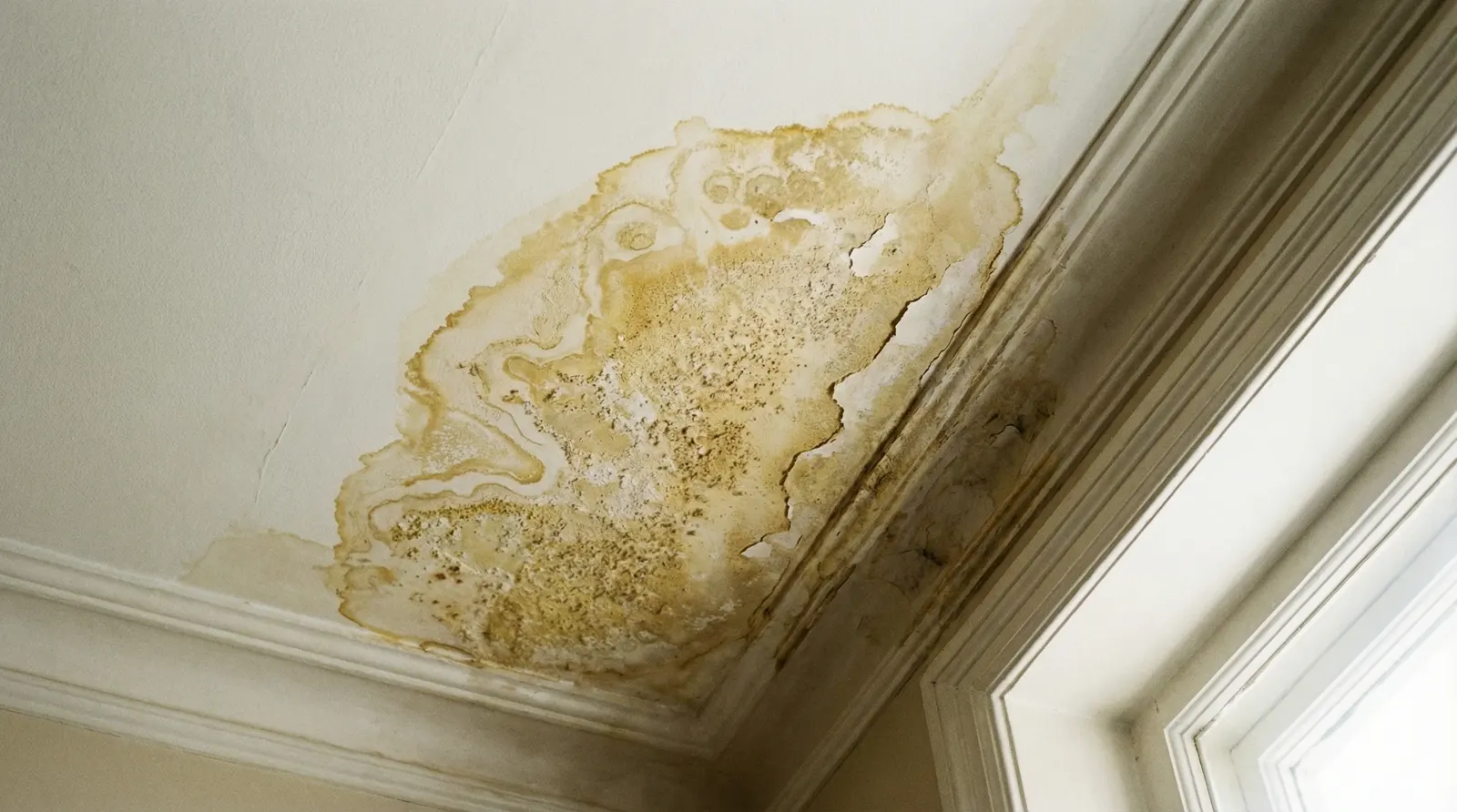
A ceiling water stain is your roof’s way of filing a report. It tells you water has been travelling where it should not – through the roof, across the attic, into the ceiling – usually for longer than you would like to know. But stains are not all equal. Their colour, edges, growth pattern and timing encode real information about what is happening above them, and reading that information correctly decides whether you need a roofer this week or a monitoring plan and a spring booking.
Key Things to Remember
- A classic active-leak stain is tan to brown with a darker ring at its edge – the tide line of minerals and dirt the water carried and deposited as it dried.
- Previous owners paint over stains, and old leaks get fixed while their stains remain – so the first question is always whether yours is alive.
- Some stains are urgent. A stain that is growing visibly between storms, drywall that is soft, bubbling or sagging, any drip – however slow – and stains accompanied by a musty smell that is strengthening all describe active water doing active damage: wet insulation losing its performance, decking beginning to soften, and conditions for mould establishing inside the ceiling assembly.
- Some stains honestly can be watched – that is a legitimate category, not procrastination, when the evidence supports it.
- Do not start by painting over an active stain – stain-blocking primer over a live leak just hides the evidence while the damage continues, and it destroys the diagnostic information your roofer needs.
Contents
Reading the Stain: Colour, Rings and Edges
A classic active-leak stain is tan to brown with a darker ring at its edge – the tide line of minerals and dirt the water carried and deposited as it dried. Concentric rings, like a target, mean the spot has wetted and dried repeatedly: an intermittent leak that has been active across multiple storms. A stain that is uniformly dark and soft to the touch is wet now – an active leak in progress or very recent. Yellowish staining that appears in a bathroom and fades in dry spells may be moisture and condensation rather than a roof leak at all.
The location carries information too. Stains tracking exterior walls suggest eave, gutter or ice-dam problems. Stains around chimneys and in rooms below roof junctions point at flashing. A stain in a bathroom ceiling, oddly, most often means the vent pipe boot directly above it – the plumbing vent and the bathroom below it are on the same stack. And a stain far from any wall, under an open slope, may have travelled from a valley or penetration uphill of it – water runs along the deck before it drips.
Old Stain or Active Leak? The Tests That Tell
Previous owners paint over stains, and old leaks get fixed while their stains remain – so the first question is always whether yours is alive. The pencil test is definitive and free: trace the stain’s outline lightly in pencil and date it. If the stain grows past your line after the next rain, the leak is active. If it never moves across several storms, you are likely looking at history. A moisture meter, or simply pressing the back of your hand and then a dry tissue against the stain after rain, tells you whether the drywall is currently wet.
Check the attic above the stain if you can do it safely from the hatch with a flashlight. Fresh dark staining on the deck underside, damp insulation or active dripping confirm the leak is live and show roughly where its path runs. Musty smell in the attic is a supporting witness – chronic moisture announces itself there first.
- Pencil-outline test: growth after rain = active leak
- Tissue test: damp drywall after rain = water arriving now
- Attic check: fresh deck staining and damp insulation confirm it
- Concentric rings = repeated wetting over multiple storms
- Bathroom stains that fade in dry weather may be condensation instead
Roof problem in Perth Amboy? Talk to a roofer, not a form.
When a Stain Means ‘Call This Week’
Some stains are urgent. A stain that is growing visibly between storms, drywall that is soft, bubbling or sagging, any drip – however slow – and stains accompanied by a musty smell that is strengthening all describe active water doing active damage: wet insulation losing its performance, decking beginning to soften, and conditions for mould establishing inside the ceiling assembly. Water damage compounds quietly; the repair cost of the roof problem stays roughly the same while the interior damage bill climbs month by month.
Equally urgent, for the opposite reason: a stain that appears suddenly and large after a storm may mark storm damage – lifted shingles or a puncture – that is still open to the next rain. After any serious Perth Amboy storm, new ceiling stains deserve a prompt roof inspection, because the opening above them is usually still there.

How Long Can You Safely Watch a Stain?
Some stains honestly can be watched – that is a legitimate category, not procrastination, when the evidence supports it. A stain that has passed the pencil test across several solid storms, with firm drywall, no smell and no change, is history rather than news. It can wait for a convenient season and a calm decision. But watching has to mean something active: the pencil outline drawn, the dates written, the tissue test repeated after heavy rain. A glance every few months while a stain quietly does what it wants is not monitoring; it is just not looking.
Set yourself a hard rule and the decision makes itself: the outline is crossed twice, the drywall feels soft once, or a musty smell arrives – the watching period is over and the call gets made. What is at stake in the timing is not the ceiling itself. Drywall is cheap and a ceiling repaint is a weekend. The hidden ledger is what grows while an active leak is watched: insulation that loses its performance permanently once wet, decking edges softening where the water path crosses them, and mould establishing inside a ceiling assembly that cycles wet and dry. Perth Amboy’s older plaster-and-lath ceilings raise the stakes further – plaster holds water longer than drywall and, once saturated, can let go in sheets rather than stain politely.
One or two monitored storms is a reasonable observation window. A whole season of ‘keeping an eye on it’ is how a flashing repair becomes a decking repair with a ceiling replacement attached.
What Happens Next (and What Not to Do)
Do not start by painting over an active stain – stain-blocking primer over a live leak just hides the evidence while the damage continues, and it destroys the diagnostic information your roofer needs. Do not climb onto the roof to look: from the ground and the attic, everything needed for a first assessment is visible, and a wet or ageing roof is no place for a homeowner. Do photograph the stain with dates; that timeline is genuinely useful evidence.
The professional response is a traced repair: the entry point found (it will rarely be directly above the stain), repaired properly, and the ceiling left to dry fully before any cosmetic work. If your stain is in Perth Amboy or the surrounding towns, call ProLine at (732) 380-0000 – describe where the stain is and when it grows, and that description will already have started the diagnosis.
Roofing Support for Perth Amboy Homeowners: ProLine Roof Repair
ProLine Roof Repair is a local roof repair service based in Perth Amboy, built around one idea: find the real problem, repair it properly, and let you talk to a roofer directly – never a form, never a call centre. If this article sounds like your roof, the next step is a proper look at it.
ProLine Roof Repair Perth Amboy NJ
155 Co Rd 616, Perth Amboy, NJ 08861, United States
Phone: (732) 380-0000
Emergency roof repair available
Regular service: Monday-Sunday, 9:00 AM – 5:00 PM
All Our Roof Repair Services
Every service below is one direct call away. No forms and no obligation – pick your problem and talk to a roofer.